A busy year for MEWR, NEA and PUB
Speech by Dr Vivian Balakrishnan, Minister for the Environment and Water Resources, Committee of Supply Debate, 11 March 2014 (Section A)
Date Published: 11 Mar 2014
1. Mdm Chair, my colleagues in NEA, PUB and MEWR have had a very busy year. In the space of 12 months, we have had to confront the worst haze episode ever; the worst dengue outbreak ever; we still had a couple of localised flash floods to deal with, and now we have the most prolonged dry spell ever. February has been the driest month on record and also the windiest month on record. We seem to be bent on breaking new records all the time.
Sustainable development makes good business sense, especially in Singapore

The world is currently at several inflexion points. There are now more than seven billion human beings on the planet, and more than half of us live in cities. Indeed, the most essential elements of life – food, water – are now interlinked with energy, and with fossil fuels. And this portends therefore, either a potential crisis or enormous opportunities for businesses in the years ahead.
In the past, great fortunes were made by simply extracting resources, mining materials – iron ore and energy – from the ground. And manufacturing grew enormously, on the back of the availability of cheap resources and cheap energy. But this era of cheap natural resources is coming to a close. And we can now no longer afford to ignore the externalities of industrialisation and of human activities. Pollution and global warming are real phenomena, which affect not just the quality of the environment, but also involves huge economic costs for all of us. In other words, the old ways of getting rich are not going to be viable in the future.
Our world is changing profoundly at an unprecedented rate. We need a coalition of the government, private companies and NGOs to protect human welfare, the fragile ecosystem and biodiversity. We have to get the economics right too.
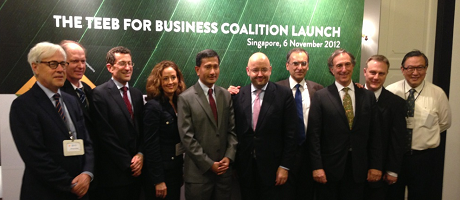 Transcript of my speech at the launch of the “The Economics of Ecosystems and Biodiversity for Business Coalition” at the Singapore Botanic Gardens on 6 November 2012
We live in a world, which perhaps unwittingly, has gone through a series of inflexion points at a rate which is unprecedented. Let me cite a few of these.
First, our world population has now exceeded seven billion. Clearly, that is unprecedented. Not only that, but for the first time ever in human history, more than half of all human beings live in a city, and not in the rural countryside. This is another world first.
Why governments, private sector and citizens all over the world need to collectively confront the looming crises of demographics, urbanisation, food-water-energy shortages, biodiversity, environmental integrity and human welfare
I attended the launch of the Economics of Ecosystems and Biodiversity for Business Coalition on 6 November 2012.
- Our world has rapidly passed through a series of inflexion points.
- First, our world population has exceeded 7 billion.
- Second, more than half of all human beings live in cities.
- Third, the age of cheap and plentiful natural resources – when we could literally scrape coal, iron ore, oil, gas easily from the surface of the planet – is ending.
- Fourth, we are running out of fresh water on a global scale.
- Fifth, the nexus between energy, water and food means we desperately need another agricultural revolution in the next decade or so.
- Sixth, we cannot afford to continue to simply dump pollutants, waste, toxins and carbon dioxide into the atmosphere and seas regardless of their impact on human health and safety and planetary ecology.
- Seventh, globalisation and information revolution has created enormous opportunities for billions of people from developing countries, but it has also created enormous competitive pressure on everyone. It has completely transformed the nature and value of employment and enterprise in half a century – probably a rate of change that is unparalleled in human history. It has also increased disparities between those able to exploit opportunities and those left behind.
Sustainable development
Congratulations to Carrie-Anne Ng Tian Ling, Nicholas Lim Jun Yong and Luigi Marshall Cham from Anderson JC for winning Stockholm Junior Water Prize

Carrie-Anne Ng Tian Ling, Nicholas Lim Jun Yong and Luigi Marshall Cham of Anderson Junior College made Singapoer proud by winning the Stockholm Junior Water Prize with their research project on using clay to remove pollutants from wastewater. They received their prize from Crown Princess Victoria of Sweden at the World Water Week in Stockholm on the 29th August 2012.
We are all very proud of you !