Sustainable development makes good business sense, especially in Singapore
The world is currently at several inflexion points. There are now more than seven billion human beings on the planet, and more than half of us live in cities. Indeed, the most essential elements of life – food, water – are now interlinked with energy, and with fossil fuels. And this portends therefore, either a potential crisis or enormous opportunities for businesses in the years ahead.
In the past, great fortunes were made by simply extracting resources, mining materials – iron ore and energy – from the ground. And manufacturing grew enormously, on the back of the availability of cheap resources and cheap energy. But this era of cheap natural resources is coming to a close. And we can now no longer afford to ignore the externalities of industrialisation and of human activities. Pollution and global warming are real phenomena, which affect not just the quality of the environment, but also involves huge economic costs for all of us. In other words, the old ways of getting rich are not going to be viable in the future.
Political suicide vs Demographic extinction
Like many Singaporeans, I would also prefer to have a smaller population of foreigners in our Singapore but ……
We are facing the crisis of our lifetime. Our citizen population will halve every two generations. This is a serious ‘long’ term problem and the only cure is more babies. But the real emergency is not babies, but ageing. That is why the population will increase in the short term before the inevitable decrease in the long term.
Our world is changing profoundly at an unprecedented rate. We need a coalition of the government, private companies and NGOs to protect human welfare, the fragile ecosystem and biodiversity. We have to get the economics right too.
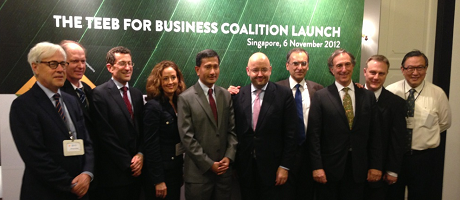 Transcript of my speech at the launch of the “The Economics of Ecosystems and Biodiversity for Business Coalition” at the Singapore Botanic Gardens on 6 November 2012
We live in a world, which perhaps unwittingly, has gone through a series of inflexion points at a rate which is unprecedented. Let me cite a few of these.
First, our world population has now exceeded seven billion. Clearly, that is unprecedented. Not only that, but for the first time ever in human history, more than half of all human beings live in a city, and not in the rural countryside. This is another world first.
Why governments, private sector and citizens all over the world need to collectively confront the looming crises of demographics, urbanisation, food-water-energy shortages, biodiversity, environmental integrity and human welfare
I attended the launch of the Economics of Ecosystems and Biodiversity for Business Coalition on 6 November 2012.
- Our world has rapidly passed through a series of inflexion points.
- First, our world population has exceeded 7 billion.
- Second, more than half of all human beings live in cities.
- Third, the age of cheap and plentiful natural resources – when we could literally scrape coal, iron ore, oil, gas easily from the surface of the planet – is ending.
- Fourth, we are running out of fresh water on a global scale.
- Fifth, the nexus between energy, water and food means we desperately need another agricultural revolution in the next decade or so.
- Sixth, we cannot afford to continue to simply dump pollutants, waste, toxins and carbon dioxide into the atmosphere and seas regardless of their impact on human health and safety and planetary ecology.
- Seventh, globalisation and information revolution has created enormous opportunities for billions of people from developing countries, but it has also created enormous competitive pressure on everyone. It has completely transformed the nature and value of employment and enterprise in half a century – probably a rate of change that is unparalleled in human history. It has also increased disparities between those able to exploit opportunities and those left behind.
Sustainable development
It is not possible to predict the future. But we must evolve, and cope with the consequences of future megatrends, e.g. climate change, extreme storms, extended droughts, water scarcity, land scarcity, energy costs, resource scarcity and food production
PUB recently announced new measures to increase flood protection at upstream areas of the Stamford Canal catchment area, including Orchard Road.The new measures include the construction of a new diversion canal to divert stormwater from about 240 hectares, or 38%, of the Stamford Canal catchment to Singapore River. Complementing the diversion canal is a detention tank which will be built to capture excess stormwater from the existing drains along Holland Road. These measures will enhance drainage capacity for this upstream area and protect it against potentially more intense storms in the future.
Build the most beautiful city you can; plant as many trees as you can; invest in the latest technology; conserve water, energy and resources; and find honest, competent and visionary leadership
 I spoke at the Opening Plenary of the Singapore International Water Week 2012, World Cities Summit and CleanEnviro Summit. Professor Tommy Koh, who was the moderator, asked:
“Minister, my question to you is two-fold. First, this plenary brings together our colleagues from water, city and the environment. What is the common thread that ties the three together, and what are some lessons learned that you would like to share with us?”